

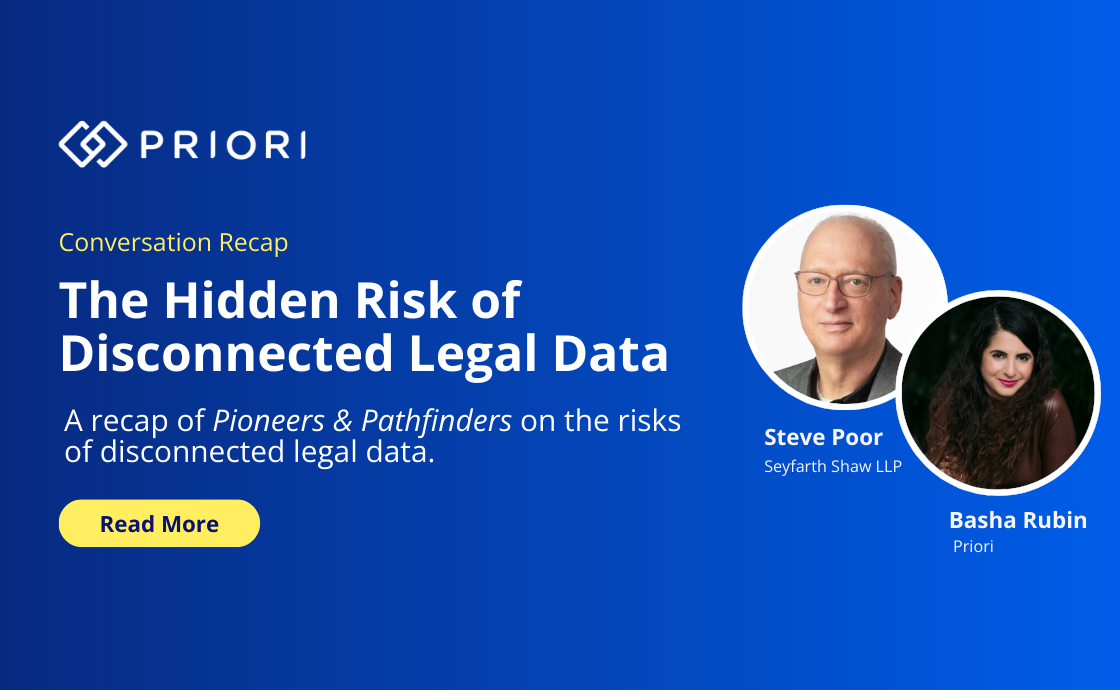
Priori CEO and Co-Founder Basha Rubin recently joined Steve Poor on the Pioneers and Pathfinders podcast to discuss how legal departments are navigating AI, outside counsel governance, and the growing complexity of legal data. Below are our team’s key takeaways from the conversation.
Legal departments don’t suffer from a lack of data. They suffer from not being able to use it.
In the discussion, Basha reflected on what she consistently hears from general counsel and legal operations leaders: billing data, performance data, panel data, RFP history, and institutional knowledge all exist — but they’re fragmented. They live in different systems. They’re inconsistently structured. And they’re rarely accessible at the moment they actually matter.
That’s where the risk lives.
The “Many-to-Many” Problem
When you zoom out, the structural complexity becomes obvious.
Large legal departments often manage:
- Hundreds, sometimes thousands, of in-house lawyers
- Hundreds of outside firms, formally impaneled or not
- Multiple e-billing systems and dashboards
- RFP histories sitting in inboxes or shared drives
- Performance insights that live only in attorneys’ heads
Experience and expertise live on firm websites. Billing data lives in systems that are difficult to interrogate. Institutional memory walks out the door when someone changes roles. Individually, each system makes sense. Collectively, they create fragmentation.
As Basha noted in the conversation:
“They really need all of that data in one system of record in order to be able to query it, understand it, and make sure that they are making smart hiring decisions.”
When outside counsel decisions are made across that landscape, the absence of a unified view isn’t just inconvenient. It’s a material governance gap.
The Cost of Disconnected Systems
Outside counsel conversations often focus on cost savings. But the true cost of disconnected systems is broader.
First, there’s the risk of not securing the best legal advice or representation for a specific matter.
Second, there’s pricing volatility. Without accessible historical data, rate benchmarking, and performance comparisons, costs vary widely. Teams attempting to move toward alternative fee arrangements or tighter budget governance struggle to identify patterns across matters, firms, and time.
Third ( and increasingly important) is defensibility.
As Basha shared:
“We really like to think of ourselves as a control center and a governance platform for outside counsel hiring… I think we’re out of the ‘no one ever got fired for hiring Kirkland’ era.”
Outside counsel selection now needs to withstand scrutiny — from finance, procurement, executive leadership, and sometimes the board.
When data exists but cannot be accessed, surfaced, and applied in context, decisions default to habit. That is the hidden risk.
The Data Exists — But Rarely at the Moment It’s Needed
One of the most consistent refrains in the conversation: Legal teams have the data. They just can’t get to it when they need it.
Rate data may sit in an e-billing system. Performance feedback may live in someone’s inbox. Panel criteria may be buried in a policy document.
But when a lawyer is deciding who to hire for a new matter, that intelligence is rarely integrated into the workflow. The hiring decision happens first. The analysis happens later (if at all.)
As Basha put it:
“They have tons of systems of record where all of this data exists, but it can’t be accessed at the moment they’re making an outside counsel hiring decision.”
Modern legal departments don’t need more dashboards. They need relevant information surfaced at the moment of decision.
Why This Matters Even More in the AI Era
AI is accelerating pressure on how legal work is performed — who does it, what it costs, and how value is measured.
From the conversation: “AI is putting more up for grabs — who should be doing legal work, what that legal work should look like, how different tooling should be used, and how it should be priced… it’s not business as usual anymore.”
As insourcing expands, alternative providers mature, and flexible talent becomes more mainstream, the question of where work goes is becoming more complex.
In that environment, disconnected data creates strategic vulnerability.
The teams that will thrive in this next era will treat outside counsel selection not as an administrative workflow, but as governed decision-making infrastructure. Because outside counsel decisions are not small decisions. They are high-stakes, often high-dollar choices that shape legal outcomes and financial performance. They deserve a system that reflects that reality.
From Fragmentation to Governance
The takeaway from the conversation is clear: Disconnected legal data is a hidden risk — but it’s solvable. When data is normalized, integrated, and embedded directly into the hiring workflow:
- Decisions become more consistent
- Pricing conversations become more grounded
- Institutional knowledge becomes durable
- Governance becomes proactive rather than reactive
And organizations can answer a simple but powerful question: Why did we hire this firm for this matter? Being able to articulate a clear, data-informed rationale, reflects a fundamentally different level of maturity.
Request a demo to see how Priori helps legal teams unify data and make smarter, defensible outside counsel decisions.