

This blog series builds on a recent joint webinar with Priori, Harbor, and LexisNexis CounselLink® on what it takes to manage legal spend end-to-end—from RFP through Accounts Payable (AP).
Speakers included Basha Rubin (CEO & Co-Founder, Priori), Kevin Clem (Chief Growth Officer, Harbor), Dan Ruderman (Director of Strategic Partnerships, LexisNexis CounselLink®), Russ Philpott (Director of Legal Operations & Corporate Counsel, Okta) and An Trotter (Senior Director of Operations, Hearst).
Legal departments have invested heavily in the building blocks of spend management—RFPs, alternative fee arrangements, eBilling/ELM platforms, preferred panels, and rate reviews. Each promises value. But too often, these pieces still operate in isolation.
That’s the gap this series is focused on: not whether legal teams have tools, but whether the workflow is connected end-to-end—so decisions made during firm selection carry through into budgeting, billing, and reporting.
The reality: demand keeps rising, but spend expectations don’t
Legal teams are operating in a familiar bind, only sharper. Demand for legal services continues to rise, but budgets and resourcing aren’t keeping pace. At the same time, AI has become a growing priority. Departments are investing in it, and also evaluating how it may change the cost structure of legal work.
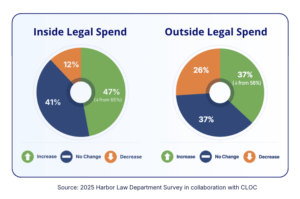
Harbor’s Law Department Survey (in collaboration with CLOC) reflects this pressure. Only 47% of respondents anticipate an increase in inside legal spend (down from 65% the prior year), and 37% anticipate an increase in outside counsel spend (down from 58%).
As Kevin Clem, Chief Growth Officer at Harbor, summed it up: “With that context, tighter constraints on spend, which then leads to tighter constraints on staffing, while investing in AI, it’s a very dynamic time to be in this space.”
If the spend picture is tightening, the next question is how legal departments are responding.
Legal ops is responding—but the action is fragmented
Most departments are actively implementing or improving formal spend controls and outside counsel governance—things like AFAs, rate reviews, competitive bidding/RFPs, preferred provider panels, and stricter approval processes.
The challenge is that these efforts often operate in silos—separate workflows, separate systems, separate data. That fragmentation makes it harder to enforce pricing and scope, prove savings, and build a repeatable operating model across the department.
When each initiative runs as its own track, the department loses the ability to connect decisions (how a firm was selected and priced) to outcomes (what was actually billed, paid, and learned for next time). The live poll results from the webinar show just how wide that gap still is.
The webinar poll results: tools exist, but the workflow is broken
The live audience polls from the session made the gap clear:
- Do you have an RFP tool? Yes 28% / No 72%
- Do you use an eBilling tool? Yes 74% / No 26%
- Do you have a business process for RFPs and eBilling to speak to each other? Yes 6% / No 94%
That last number is the story. Even when departments have modern systems, almost none have an end-to-end process that connects how firms are selected and priced to how matters are tracked, billed, and paid.
Why the handoff is where spend control breaks
Legal departments have made huge progress on the “back end” of spend management— eBilling, billing guidelines, invoice review, reporting. At the same time, more teams are investing in the “front end” of outside counsel decision-making—formal sourcing processes, competitive bids, clearer scoping, and more disciplined pricing structures.
But if the output of the front end (scope, staffing assumptions, rates or AFAs, budgets) doesn’t carry through into the systems that govern the back end (eBilling and AP), you lose the advantage. You can negotiate the right deal—and still fail to realize it.
That’s the missed opportunity this series is focused on: not “more tools,” but a connected workflow where each stage reinforces the next.
Where we’re going next
In Part 2, we define what “end-to-end” actually means in practical terms, and what it looks like when RFP and eBilling are treated as one continuous lifecycle instead of two separate systems.
Source note: The market data referenced above comes from Harbor’s Law Department Survey (in collaboration with CLOC), as shared during the webinar and in Harbor’s published survey materials.
See what “RFP to AP” looks like in practice. Request a demo of Priori’s end-to-end outside counsel workflow.