


AmLaw 50 firms grew revenue 13.3% last year. Billing rates accounted for 10.4 points of that. Hours grew just 3.6%. Your firms got more expensive faster than they got busier.
That math is forcing a question into every legal department does this matter actually justify the firm — and if not, where can the work go without sacrificing quality?
Strong relationships should inform where work goes. But when the answer is always “send X to Firm Y,” the relationship has stopped being part of the strategy and started becoming the strategy. That’s where teams lose leverage.
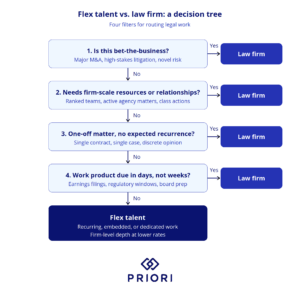
Here’s a cleaner test. Four filters. If the answer is “no” to all four, it belongs with flex talent. If any one is “yes,” send it to your firm.
The Tree
- Is this bet-the-business?
- Does this require a firm’s bench, brand, or institutional relationships?
- Is this a single, one-off matter with no expected recurrence?
- Is the completed work product due in days, not weeks?
A “yes” to any of the four → law firm. Four “no’s” → flex talent.
Filter 1: Bet-the-Business Work
Some matters belong with your firm because the cost of being wrong dwarfs the cost of the engagement. The tell is usually one of three things: the dollar exposure is material to the business, the outcome is irreversible or the reputational risk extends beyond the legal department. Some examples: major M&A, high-stakes litigation, novel regulatory exposure, or board-level matters.
This is where you want institutional credibility and the kind of judgment that comes from having seen the exact situation a hundred times. Routing this work to flex isn’t smart sourcing — it’s a false economy.
Filter 2: Firm-Only Specialty Work
Some practice areas need more than deep expertise. They need firm-scale resources or institutional relationships that individual attorneys don’t carry on their own. Ranked patent litigation teams. Active SEC or FDA matters where the firm’s standing relationships matter. Large-scale class action defense. Complex tax structuring requiring a coordinated team.
This isn’t about flex networks lacking specialists. Priori’s network spans 8,000+ attorneys across most practice areas, including deep substantive specialties. It’s about a narrow category of work where the firm itself (not just the individual lawyer) is the value.
That work belongs at the firm.
Filter 3: One-Off Matters
If a matter is going to last 10 or 20 hours and then disappear, flex doesn’t always make sense. Not because of the rates, but because of the setup time.
By the time you scope the work, get matched with an attorney, run an interview, and sign an SOW, your firm could have already finished and sent the bill. The math doesn’t work for either side.
Your firm relationships exist for exactly these moments. A partner who knows your business picks up the phone and gets it done. Flex talent pays dividends when there’s a sustained body of work on the other side of it — recurring contracts, ongoing coverage, a practice area you need supported for a quarter or more. When a matter starts and ends in the same breath, that investment doesn’t have time to earn back.
Filter 4: Time-to-Value
Some matters don’t just need an attorney — they need completed work product, fast. Earnings-related filings, regulatory response windows, board meeting prep, government investigations. When the deadline is days away, your firm has someone who can execute immediately. The relationship is already built and the context is already there.
Flex talent moves fast — sourcing typically takes days, not weeks, and our attorneys are senior enough to ramp quickly. But when completed work product is due in 48 hours, even a fast start has limits. Your firm already has the context. That matters when there’s no runway.
When in doubt, ask about timing. We’ve placed a securities lawyer with a client inside a week to handle a proxy filing — but that engagement was substantial enough to make the sourcing worth it for everyone involved.
Related: Unbundling Legal Work Is Often the Missing Layer Behind Better Pricing
What’s Left: Flex Talent Work
Everything that survives those four filters is, almost by definition, the work flex talent was built for:
- Recurring, repeatable work. Commercial contract queues. NDA volume. Standard tech transactions. Work that benefits from a dedicated attorney who learns your playbooks.
- Embedded coverage. Parental leave, leadership gaps, capacity surges. One client used flex to embed a privacy attorney for six months during their CPO’s leave — work that would have otherwise rolled to outside counsel.
- Specialized in-house capacity. Niche expertise you need part-time, not a full headcount.
For this kind of work, Priori’s network gives you firm-level depth without firm-level overhead. Pricing typically lands 50%+ below AmLaw 50 partner billing rates — a downstream effect of routing right, not the reason to route flex.
Why This Beats Routing on Habit
Most legal departments still route by relationship. That made sense when “outside legal help” meant “your firm.” It doesn’t anymore.
What’s changed is the menu. You now have a real second option for the work that doesn’t need firm-level pricing or firm-level overhead and a cleaner way to decide which is which.
The tree above isn’t a tool for moving away from your firm. It’s a tool for using your firm well and routing everything else to where it actually fits.
Priori helps enterprise legal teams match the right work to the right resource. Find legal talent today.