


If you’ve been following the FlexFest agenda, you’ve probably noticed a few terms showing up across sessions, speaker descriptions, and the conversations we’ve been having leading up to July 29. Some are familiar. Some are newer. And a few mean something different depending on who’s using them.
Here’s how we’re thinking about the terms and phrases that may come up, and why each one matters for how legal work gets done going forward.
Unbundling
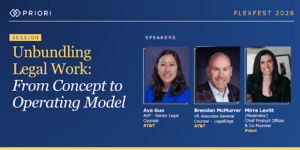
Unbundling is the practice of breaking legal work into its discrete components and being intentional about how each one gets handled — whether that means routing it to a different provider, centralizing it under a specialized internal team, or redesigning the workflow around AI-enabled tools. The concept has been around for years, but what’s changed is that departments are moving past the theory and into execution. AT&T built an entire unit, called LegalEdge, around this idea, combining attorneys, legal ops, and eDiscovery professionals to rethink how legal work gets approached from the ground up. AT&T’s Brendan McMurrer and Ava Guo will walk through what that looks like in practice at FlexFest.
AI-Native Services
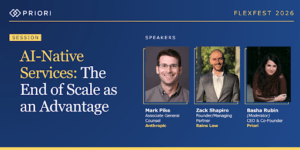
An AI-native legal service provider is one built from the ground up around AI-enabled workflows rather than retrofitting AI onto a traditional delivery model. These providers tend to be smaller, leaner, and faster, and they’re raising a real question about whether scale remains the competitive advantage it’s always been in legal services. At FlexFest, Anthropic’s Mark Pike and Rains Law’s Zack Shapiro will explore what this means for the competitive landscape.
Agentic Legal
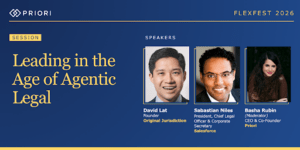
Agentic legal refers to the shift from AI as a tool lawyers use to AI as an agent that executes tasks independently within legal workflows — drafting, researching, triaging, routing, and flagging issues without waiting for a human to initiate each step. The difference matters because it changes what in-house teams expect from their service providers. A firm or ALSP that can deploy intelligent workflows and AI agents alongside human expertise looks fundamentally different from one that’s still selling hours. At FlexFest, Sabastian Niles (Salesforce) and David Lat (Original Jurisdiction) will explore what this means for legal service delivery, and what it takes to lead in the age of agentic legal.
Insourcing
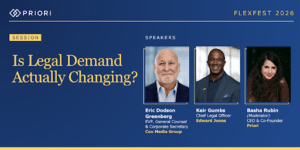
Insourcing is the deliberate shift of legal work from outside firms to in-house teams, often accelerated by AI tools that make it more cost-effective to handle work internally. Where unbundling asks “how do we distribute this work across the right providers,” insourcing asks “how much of this work should we be handling ourselves.” Some of the departments furthest along on this shift have moved from majority-outside to majority-inside over a decade, driven by both cost and the strategic value of building institutional knowledge in-house. Eric Dodson Greenberg (Cox Media Group) and Keir Gumbs (Edward Jones) will discuss how their teams have approached this rebalancing at FlexFest.
AI Dividend Program
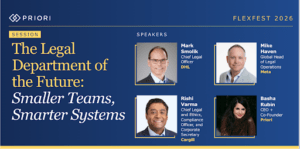
An AI dividend program builds AI adoption directly into individual performance accountability. Rather than treating AI as a top-down rollout, the CLO asks each direct report to identify their own AI-driven efficiency gains: capacity constraints they can address, pain points they can eliminate, or ways they can simplify their function using AI. Rishi Varma (Cargill) has embedded this into his team’s quarterly objectives, and one early result was Cargill’s IP team layering AI on top of their patent database and eliminating outside counsel for that function. Rishi will share more about how his team is approaching this at FlexFest as part of The Legal Department of the Future panel.
Bionic Boutique
The bionic boutique is a small law firm (often a break-off from big law) that uses AI to deliver work that historically required the scale of a major firm. The term captures a specific bet: that the barrier keeping boutiques out of complex, high-stakes matters was never judgment or expertise, but execution capacity. AI collapses that barrier. And the incentives at smaller firms tend to favor faster adoption, since efficiency gains translate directly to margin rather than getting distributed across a partnership. Eric Dodson Greenberg (Cox Media Group) and Keir Gumbs (Edward Jones) will dig into where these new provider types are actually gaining traction, and where big law still holds the work at FlexFest.
FlexFest
FlexFest isn’t only about flexible talent. It’s about an industry that is going to need to be more flexible, where the traditional barriers are breaking down and the future is being rewritten in real time. Whether you’re a GC thinking about how work should be routed, a legal ops leader trying to make sense of the data your department already has, a flex practitioner mapping where the opportunities are, or a founder building something new — there is content designed for you. We’ve brought together CLOs, legal ops leaders, AI-native firm founders, and flex talent lawyers not to talk about one delivery model, but to talk about how to architect the future of an industry at a crossroads — and how to build a better one together.
Where These Terms Converge
None of these concepts exist in isolation. Unbundling creates the components, and insourcing determines how much of the work stays in-house. Bionic boutiques and AI-native firms expand who can credibly compete for what does go out. AI dividend programs describe how the most disciplined departments are turning AI adoption into measurable outcomes. And agentic legal points to where the delivery models themselves are headed. Together, they describe a legal operating model that looks fundamentally different from the one most departments are still running.
That’s the conversation we’re having at FlexFest on July 29. Register now.